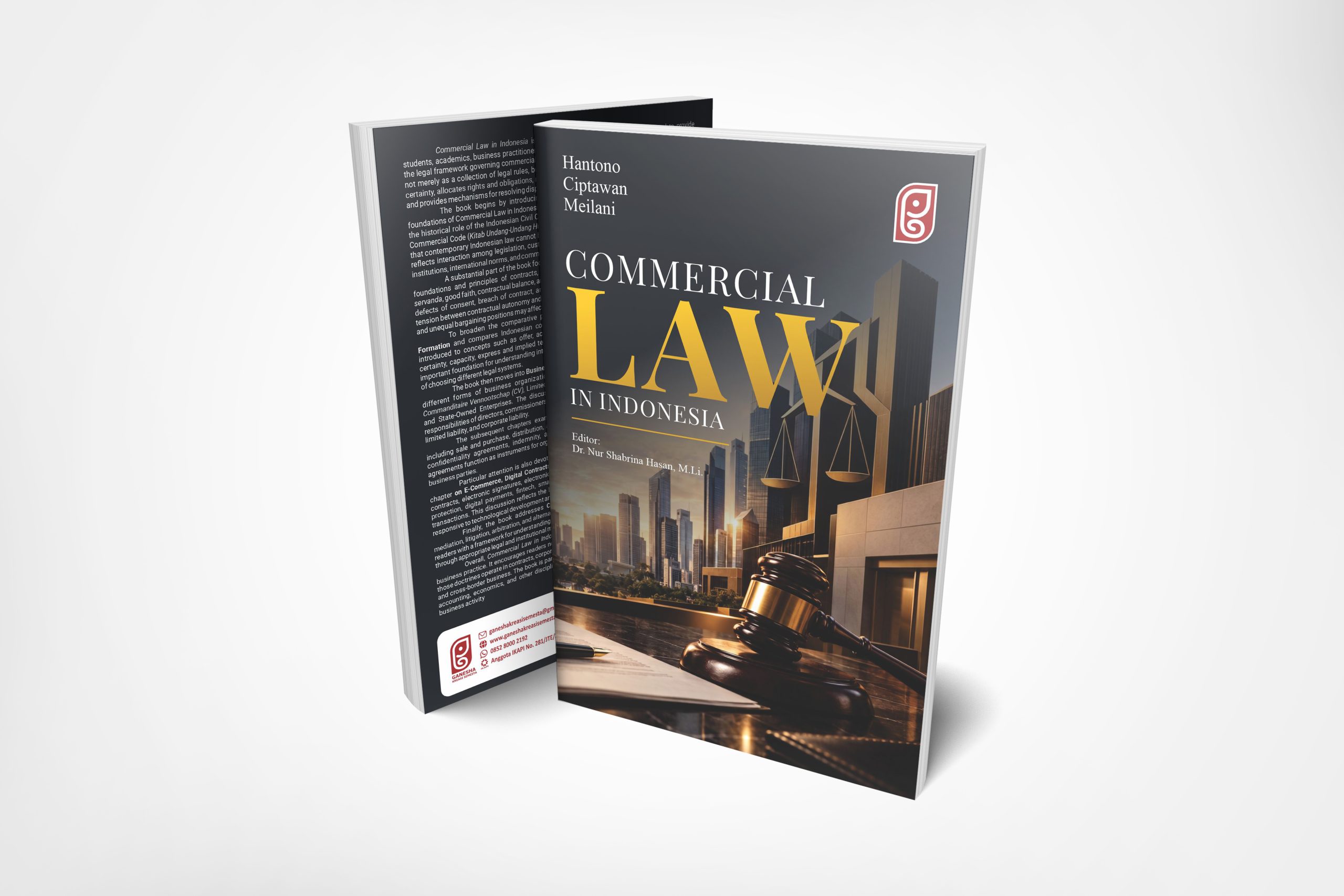
Commercial Law In Indonesia
Commercial Law in Indonesia is an academic and practical textbook designed to provide students, academics, business practitioners, and other readers with a comprehensive understanding of the legal framework governing commercial activities in Indonesia. The book examines Commercial Law not merely as a collection of legal rules, but as an essential institutional framework that provides legal certainty, allocates rights and obligations, manages commercial risks, facilitates business transactions, and provides mechanisms for resolving disputes.
The book begins by introducing the concept, scope, historical development, and legal foundations of Commercial Law in Indonesia. It explains the strong influence of the Civil Law tradition and the historical role of the Indonesian Civil Code (Kitab Undang-Undang Hukum Perdata/KUHPerdata) and Commercial Code (Kitab Undang-Undang Hukum Dagang/KUHD). At the same time, the book emphasises that contemporary Indonesian law cannot be understood simply as a purely Civil Law system because it reflects interaction among legislation, customary law, religious influences, judicial decisions, regulatory institutions, international norms, and commercial practices.
A substantial part of the book focuses on Indonesian Contract Law. The discussion covers the foundations and principles of contracts, including freedom of contract, consensualism, pacta sunt servanda, good faith, contractual balance, and legal certainty. The book also examines contract formation, defects of consent, breach of contract, and contractual remedies. Particular attention is given to the tension between contractual autonomy and contractual justice, especially where standard-form contracts and unequal bargaining positions may affect meaningful consent.
To broaden the comparative perspective, the book introduces Common Law Contract Formation and compares Indonesian contract law with the Common Law tradition. Students are introduced to concepts such as offer, acceptance, consideration, intention to create legal relations, certainty, capacity, express and implied terms, and promissory estoppel. The comparison provides an important foundation for understanding international commercial contracts and the legal consequences of choosing different legal systems.
The book then moves into Business Organizations and Corporate Law in Indonesia, discussing different forms of business organizations, including sole proprietorships, partnerships, Firma, Commanditaire Vennootschap (CV), Limited Liability Companies (Perseroan Terbatas/PT), cooperatives, and State-Owned Enterprises. The discussion continues with corporate governance, the roles and responsibilities of directors, commissioners, and shareholders, fiduciary duties, separate legal personality, limited liability, and corporate liability.
The subsequent chapters examine commercial transactions and business agreements, including sale and purchase, distribution, agency, franchise, partnership, financing, services, licensing, confidentiality agreements, indemnity, and force majeure. These topics demonstrate how legal agreements function as instruments for organising commercial relationships and allocating risks among business parties.
Particular attention is also devoted to the transformation of commerce in the digital era. The chapter on E-Commerce, Digital Contracts, and Contemporary Commercial Law discusses electronic contracts, electronic signatures, electronic evidence, online marketplaces, consumer protection, data protection, digital payments, fintech, smart contracts, artificial intelligence, and cross-border digital transactions. This discussion reflects the book’s broader argument that Commercial Law must remain responsive to technological development and changing patterns of economic activity.
Finally, the book addresses Commercial Dispute Resolution, introducing negotiation, mediation, litigation, arbitration, and alternative dispute resolution mechanisms. The discussion provides readers with a framework for understanding how commercial disputes arise and how they may be resolved through appropriate legal and institutional mechanisms.
Overall, Commercial Law in Indonesia is intended to bridge legal theory and contemporary business practice. It encourages readers not only to understand legal doctrines but also to analyse how those doctrines operate in contracts, corporate relationships, commercial transactions, digital commerce, and cross-border business. The book is particularly relevant for students of law, business, management, accounting, economics, and other disciplines requiring an understanding of the legal dimensions of business activity
Author: Hantono | Ciptawan | Meilani
Editor : Dr. Nur Shabrina Hasan, M.Li.
Halaman buku: 326
DOWNLOAD
PRE-ORDER | Rp 96.000