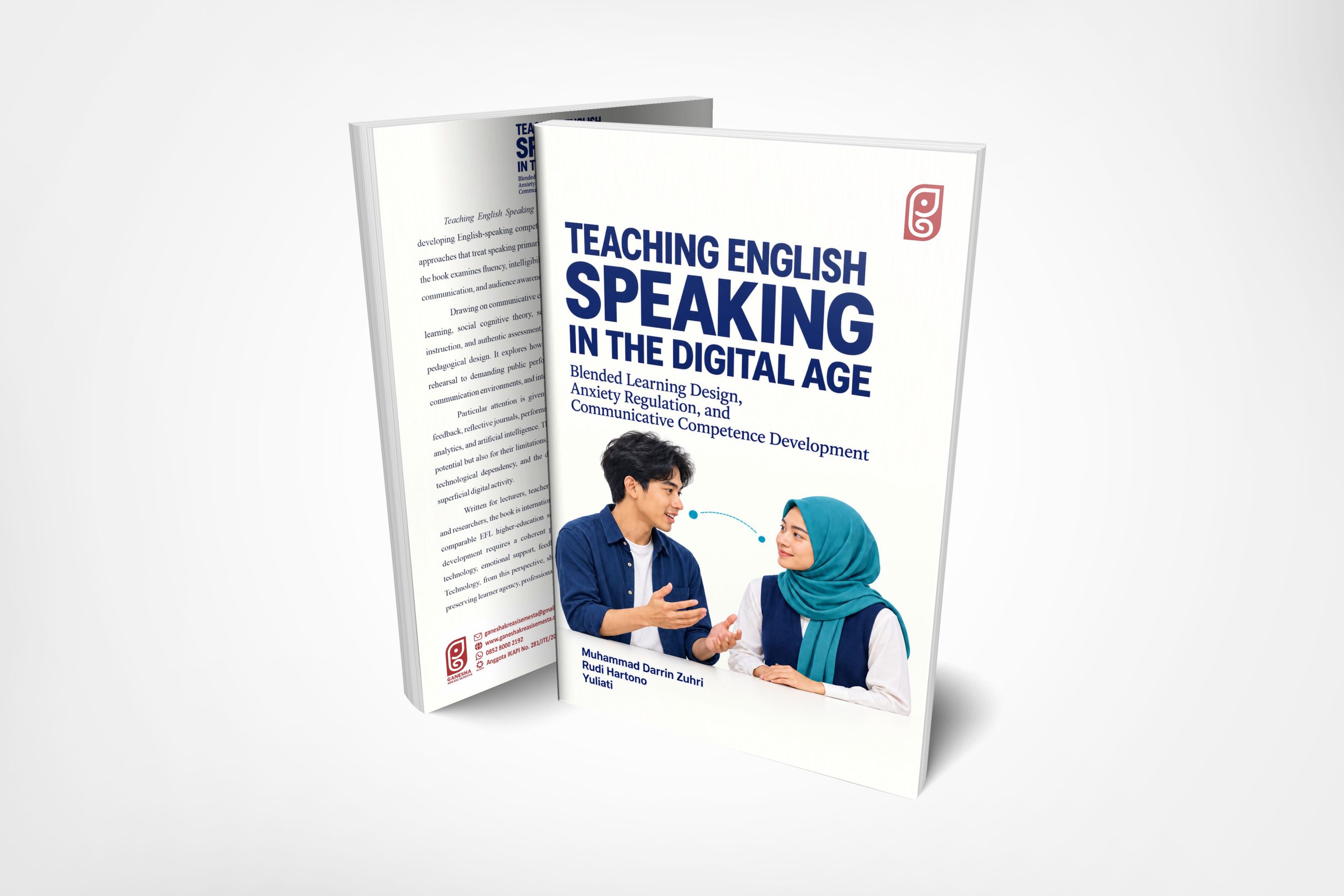
Teaching English Speaking In The Digital Age: Blended Learning Design, Anxiety Regulation,and Communicative Competence Development
Teaching English Speaking in the Digital Age offers an integrated framework for developing English-speaking competence in contemporary higher education. Moving beyond approaches that treat speaking primarily as the production of grammatically accurate sentences, the book examines fluency, intelligibility, interaction, rhetorical organization, delivery, strategic communication, and audience awareness as interconnected dimensions of performance.
Drawing on communicative competence, blended learning, constructivism, experiential learning, social cognitive theory, self-regulated learning, psychological safety, task-based instruction, and authentic assessment, the book connects established scholarship with practical pedagogical design. It explores how lecturers can sequence speaking tasks from low-stakes rehearsal to demanding public performance, reduce unproductive anxiety, build supportive communication environments, and integrate face-to-face interaction with digital learning.
Particular attention is given to self-recording, repeated practice, peer and lecturer feedback, reflective journals, performance-based assessment, rubrics, digital portfolios, learning analytics, and artificial intelligence. These practices are evaluated not only for their pedagogical potential but also for their limitations, including unequal access, privacy risks, automated bias, technological dependency, and the danger of replacing meaningful human interaction with superficial digital activity.
Written for lecturers, teacher educators, curriculum designers, postgraduate students, and researchers, the book is internationally relevant while remaining attentive to Indonesian and comparable EFL higher-education settings. Its central argument is that effective speaking development requires a coherent pedagogical ecology in which communication tasks, technology, emotional support, feedback, reflection, and assessment reinforce one another. Technology, from this perspective, should expand opportunities for purposeful practice while preserving learner agency, professional judgment, and meaningful human communication.
Authors : Muhammad Darrin Zuhri | Rudi Hartono | Yuliati
Editor: Dr. Ria Kasanova, M.Pd
Halaman buku: 490
DOWNLOAD
PRE-ORDER | Rp 125.000